Affiliate Disclosure: This site may contain affiliate links. When readers purchase through these links, we may earn a commission at no additional cost to them.
Work Sharp Precision Adjust Researched Buying Guide: Is It the Best Beginner Guided Sharpener?
The Work Sharp Precision Adjust is one of the easiest first guided sharpeners to shortlist because it solves the hardest beginner problem: holding a consistent angle. This is a researched buying guide based on product specifications, common owner feedback, and how the design compares with other beginner sharpening paths.
Short Verdict
Best for beginners who want better angle control than a pull-through sharpener without committing to freehand whetstone practice.
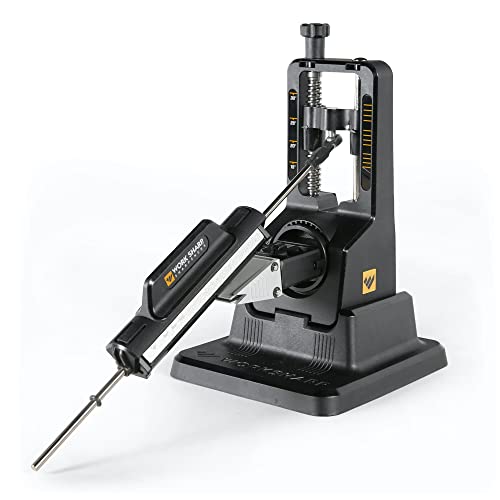
Work Sharp Precision Adjust Knife Sharpener
A clamp-and-rod guided system that gives beginners repeatable angles without learning freehand stone control first.
Price: $55-70
Who It Fits
- Beginners who want a visible angle setting instead of guessing on a stone.
- Home cooks with a few pocket or kitchen knives that need regular maintenance.
- People who want to understand edge geometry before moving to freehand stones.
Who Should Skip It
- Anyone who wants the fastest possible sharpening session should look at an electric sharpener.
- Users with many long chef knives may find clamp positioning slower than a full-size bench stone.
- People who want a traditional skill path should start with a good 1000 grit whetstone instead.
Core Specs That Matter
The practical appeal is the adjustable angle range, the clamp, and the three-stage abrasive rod. The coarse surface repairs dull edges, the fine surface refines them, and the ceramic stage is for finishing. For a beginner, the important spec is not the number of pieces in the box; it is whether the angle can be repeated on both sides.
Usage Difficulty
The main learning curve is clamping the knife consistently and using light pressure. If you move the clamp position between sessions, you may not hit the same bevel. Marking the edge with a marker before sharpening helps you see whether the abrasive is contacting the shoulder, the apex, or the whole bevel.
Common Complaints
- The clamp can feel limiting on very small, flexible, or unusually shaped blades.
- It is slower than an electric machine when several knives need work.
- The base is compact, so heavy pressure makes the setup feel less stable than it should.
Pros and Cons
Pros
- Repeatable angle control is easier for beginners than freehand sharpening.
- The coarse, fine, and ceramic stages cover repair, refinement, and finishing in one kit.
- Replacement abrasives are simpler to manage than soaking stones, oil, or flattening gear.
Cons
- Clamp setup can be awkward on very small, flexible, or unusual blade shapes.
- It is slower than an electric sharpener when several kitchen knives need work.
- Heavy pressure can make the compact base feel less stable than a full-size bench setup.
Alternatives to Consider
Choose the Lansky Deluxe if price matters more than convenience and you like fixed guide slots. Choose the Chef'sChoice 15XV if speed matters more than learning. Choose a Shapton Kuromaku 1000 if you want one serious first stone and are willing to practice angle control.
Buying Notes and Maintenance Cost
Check whether the base kit includes the grit range you need before buying add-ons. The ongoing cost is replacement abrasive plates or upgrades, not oil or water stones. Clean the abrasive surfaces after use and do not treat the coarse side as a finishing step; it removes steel faster than beginners expect.